
Our Products. One Purpose. Enabling Independence at every stage of life. The Novis Product Catalogue is LIVE. View

Transfers should be safe, smooth and dignified, for the person being lifted and for the person helping. The Molift Rail System is a ceiling hoist track that carries a Molift lifting motor and sling along a fixed route. It removes the pushing, pulling and manual lifting of moving someone from bed to chair, chair to bathroom, or room to room.
Molift has been making patient handling equipment since 1981 and invented the world’s first battery-operated hoist. Novis is proud to be the importer and distributor of Molift products in Australia.
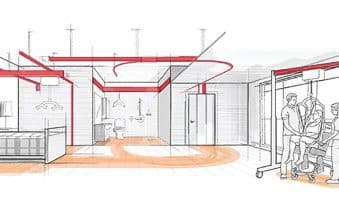
A ceiling hoist has three parts:
As the motor moves on the track, there’s no heavy equipment to push across carpet, thresholds or tight spaces, and nothing to fold away and store.
The rail system can be configured for capacities from 160 kg up to 500 kg, depending on the hoist motor selected.

Safer, easier transfers. Ceiling hoists reduce the manual effort of lifting and repositioning. This supports carers and helps lower the risk of strain injuries.
Dignified care. Smooth, controlled movement is more comfortable for the user than manual lifting.
No floor clutter. There’s no floor hoist to manoeuvre around beds, furniture or bathroom fittings.
Adapts to your space. Rails can be integrated into most ceilings and walls, including suspended ceilings, and are designed to blend with the room.
Designed to grow with changing needs. Systems can be extended, connected and upgraded over time.
Single rail system. Straight and curved rails create a simple, effective route for the most common transfers, such as bed to wheelchair. Curves are available at 30°, 45°, 60° and 90°.
Traverse rail system. Two parallel rails carry a cross rail, giving the motor coverage across the room. This is ideal for bedrooms and bathrooms where the person needs access to multiple locations.
Room to room transfer. Move between rooms with a continuing rail through a doorway, a rail or traverse switch to connect systems, or the Room to Room (Climbing) function.
Rail switches and traverse switches. A rail switch changes direction on a single rail, for example from straight to curved. A traverse switch connects a traverse system to a single rail or another system.
The rail is only half of the system. Pair it with the hoist that suits the person:
Every Molift hoist includes integrated service software, emergency lowering and an emergency stop. Sling bars come in 2-point, 4-point and bariatric options, and the Air range has a lifting interval of up to 3 metres.
For temporary or rental situations, Molift also offers free-standing gantry systems:
Both are available with Air or Nomad motor combo packs.
Molift is certified to ISO 9001:2015 (quality), ISO 14001 (environment) and meets ISO 13485 traceability requirements, with unique serial numbers on every hoist and sling. Every Molift hoist includes service software that indicates when servicing is due, helping keep the equipment safe and compliant.
Depending on your circumstances, a ceiling hoist may be funded through the NDIS, aged care programs, or private or insurance arrangements. Funding depends on individual eligibility and approvals, and an occupational therapist’s recommendation is usually required.
What is the Molift Rail System?
It’s a ceiling or wall-mounted track that carries a Molift hoist motor and sling along a set route, so a person can be transferred safely between locations such as bed, chair and bathroom
How much weight can the Molift Rail System lift?
The rail system can be built to lifting capacities of 160 kg up to 500 kg, depending on the hoist motor. For example, the Molift Air 200 has a 205 kg safe working load, the Air 350 has 350 kg and the Air 500 has 500 kg.
Can a ceiling hoist be installed in an existing home?
Often yes. The Molift Rail System can be fitted to most ceilings and walls, including suspended ceilings. A site assessment will confirm the best option.
What if the ceiling can’t support the system?
Wall-mounted rails and floor-supported options (with upright supports) are available. Free-standing gantries such as the Molift Duo and Quattro are another option.
Can the track go from the bedroom to the bathroom?
In many homes, yes. Rails can continue through doorways, or be linked with switches or the Room to Room (Climbing) function.
How is the hoist charged?
Hoists can be charged through the hand control, or automatically on the track with In-Rail Charging, so the hoist is always ready to use.
Can the NDIS fund a ceiling hoist?
It may, where the hoist is considered reasonable and necessary and supported by an OT. We can provide quotes and product information to support your application.
What’s the difference between a ceiling hoist and a floor hoist?
A ceiling hoist runs on a fixed track and uses no floor space. A floor hoist is portable but needs room to manoeuvre and storage space. Which is best depends on the person, the home and the care needs.
Can a ceiling hoist be used for standing or gait training?
Yes. The Molift Air range is suitable for sitting and horizontal transfers, as well as standing and gait training, with the right sling bar and OT guidance.
How often does a ceiling hoist need servicing?
Molift hoists have service software that indicates when servicing is due.
How do I clean it?
Clean the product with a solvent-free cleaning agent with a pH between 5 and 9, or with a 70% disinfectant solution.
Oops! We could not locate your form.